The platform
Designing functional foods with science and artificial intelligence.
Our platform integrates scientific evidence, food-composition databases, bioactive-compound information, and artificial intelligence to help design functional formulations with specific health goals.

Why we built it
Most functional foods are designed by marketing first and biology second. We flipped it. Our engine starts with the molecule — what a compound actually does inside the body — and works back to the ingredients, ratios, and processing needed to deliver it in a morning spoonful. The platform is how a small team in Ecuador can work with the depth of a global R&D lab.
The architecture
Four layers, one loop.
Our engine is built as a closed learning loop. Data flows up from open science and global food databases, gets reasoned over by our AI models, surfaces in the workbench our scientists use, and feeds back into the system every time a human improves a formula.
Data layer
Peer-reviewed papers, USDA FoodData Central, FooDB, Phenol-Explorer, EFSA datasets, regional biodiversity catalogs and our own lab analyses of Ecuadorian and Andean ingredients.
Knowledge base
A structured graph of ingredients, phytochemicals, bioactive pathways, dosages, interactions, sensory profiles and supply-chain provenance — continuously curated.
AI engine
Retrieval-augmented language models plus optimization models that score candidate formulas against a target benefit, bioavailability, allergens, cost and taste.
Human-in-the-loop UI
A workbench where our food scientists explore, accept or refine each proposal. Every decision they make is recorded as a signal that improves the next formulation.
How the layers connect
Four layers, one loop.
The human in the middle keeps the engine grounded — every accepted or rejected formula trains the next one.

How a formula is born
From a question to a product, in five steps.
- 01
Define the benefit
A scientist sets the target — e.g. daily Phase II detox support or sustained morning focus — with measurable biomarkers and dietary constraints.
- 02
Retrieve the evidence
The engine pulls relevant peer-reviewed papers, clinical trials and food-composition records into a working context for that brief.
- 03
Generate candidates
Hundreds of candidate formulas are proposed across global ingredients, scored on bioactivity, bioavailability, synergy, allergens, taste and supply feasibility.
- 04
Human review
Our food scientists compare the top candidates in the workbench, run sensory and stability tests, and refine ratios. Their edits feed back into the engine.
- 05
Validate and produce
The chosen formula is lab-validated for active compound levels per batch, then handed to production. The same loop monitors and reformulates over time.
Ecuador first — but not Ecuador only.
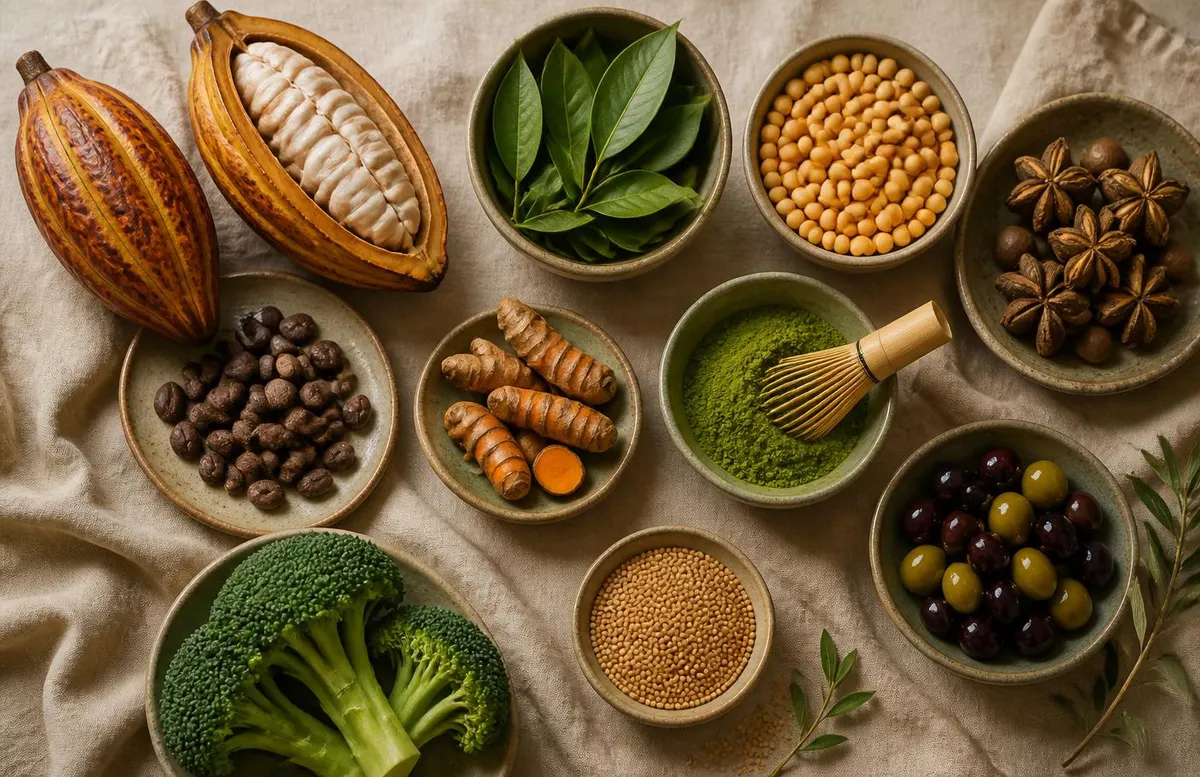
Our knowledge base is anchored in Ecuador's extraordinary biodiversity — guayusa, cacao, sacha inchi, chocho, pitahaya, borojó — because that is the pantry we know best and the one we want the world to discover. But the engine reasons over a much wider catalog: cruciferous vegetables, mustard family seeds, Mediterranean botanicals, Andean grains, Asian medicinal mushrooms, and more. We choose whatever combination delivers the benefit best and we are transparent about where every ingredient comes from.
FAQ
Common questions about the platform
Is this just a chatbot wrapped around a database?
No. The language model is one component in a larger pipeline that includes a curated knowledge graph, optimization models that score candidate formulas across multiple objectives, and a scientist workbench that captures human decisions as training signal.
Where does the data come from?
Peer-reviewed publications, public food-composition databases such as USDA FoodData Central, FooDB and Phenol-Explorer, EFSA opinions, regional biodiversity catalogs, and our own lab measurements on Ecuadorian and Andean ingredients. Every claim in a formula is traceable to a source.
Does the AI make the final decision?
Never. The engine proposes and scores; our food scientists decide. Every accepted, rejected or edited proposal is logged and used to improve the next round.
Do you only formulate with Ecuadorian ingredients?
Ecuador is our anchor, but the platform reasons over global ingredients. We pick whatever combination delivers the benefit best and is responsibly sourced.
Can other brands use the platform?
Today the engine powers Verde Origen products. We are exploring partnerships with mission-aligned brands and research institutions.
How do you handle safety, allergens and regulatory limits?
Allergens, regulated compounds and intake limits are first-class constraints in the optimization. A candidate that breaches them is rejected automatically before a human ever sees it.
Be the first to taste what the platform makes.
Our first product, VO+, is the engine's first public formulation. Join the first batch to lock founder pricing when launch opens.